About 278 minutes
The Cavalier Songs and Ballads of England from 1642 to 1684 — Inside the Classic
Science Fiction Utopias
63,746 recorded words. 2 minutes difference from this book's estimate.
View Gutenberg source #1030
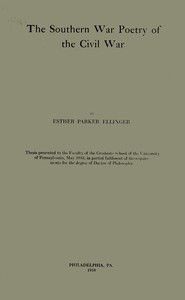
This digital edition of The Southern war poetry of the Civil War — Reading Companion is described by source-level measurements including 64,246 words, 4 hr 40 min estimated reading time, and 27 detected text sections.
The text analysis averages about 15.0 words per sentence, while the detected sections provide another way to judge how the source is divided.
Project Gutenberg metadata also associates the work with “United States -- History -- Civil War, 1861-1865 -- Poetry,” connecting these edition facts with the source record’s subject description.
Explore this collection
These alternatives are selected using recorded categories and estimated reading time.
About 278 minutes
Science Fiction Utopias
63,746 recorded words. 2 minutes difference from this book's estimate.
View Gutenberg source #1030About 286 minutes
Science Fiction Utopias
65,710 recorded words. 6 minutes difference from this book's estimate.
View Gutenberg source #35402About 292 minutes
Science Fiction Utopias
67,146 recorded words. 12 minutes difference from this book's estimate.
View Gutenberg source #63858Search stored excerpts and compare books → Choose by your preferences →
Choices use stored catalog measurements. Estimates vary with reading speed. A shared category is a catalog label, not a claim that two books have the same argument or literary quality.
Search reads excerpt text stored with this catalog and links to its associated Gutenberg record. The connection is stored in the site database; this tool does not recheck that every excerpt is word-for-word identical to that external record. Excerpt search does not cover every chapter and does not verify historical publication dates.
Catalog snapshot checked: 2026-09-25. Coverage: 96 public books, 96 available source excerpts.
Read the complete public-domain text at its original source.
Read on Project GutenbergEllinger opens her 1918 thesis with a quotation from Dunsany comparing time to a whale that “feeds on the littlest things—small tunes and little unskilled songs.” This metaphor frames her project: to recover the ephemeral war poetry of the Confederacy, much of it preserved only in rare broadsides and anthologies. She thanks collectors and librarians who granted access to “many rare and important imprints,” signaling that the study is built on primary sources rather than received opinion.
The foreword also reveals that the work was directed by Arthur Hobson Quinn at the University of Pennsylvania. Ellinger’s approach is systematic: she organizes poems by subject (e.g., “General Lee,” “Gettysburg”) and provides a comprehensive index. Readers should note that the excerpts here are limited to the front matter and a sample of the index; the full text includes chapters on significance and historical development.
Ellinger’s thesis is not a casual anthology but a doctoral dissertation that treats Confederate poetry as serious literature. She cites William Gilmore Simms’s dictum that “the emotional literature of a people” is essential to understanding them. The index lists hundreds of poems, many with airs like “La Marseillaise” or “Yankee Doodle,” showing how Southern writers adapted familiar tunes. Poems are attributed to specific authors and sources—for example, “General Hood’s Last Charge” by Mary Hunt McCaleb from an imprint, and “General J. E. B. Stuart” by John R. Thompson from the Southern Opinion. This meticulous sourcing is the backbone of the work.
The index reveals a preoccupation with military leaders: entries for Lee, Jackson, Stuart, Beauregard, and Johnston appear alongside poems about lesser-known figures like General Tom Green. Many poems employ heroic couplets or ballad stanzas, as in “General Lee At the Battle of the Wilderness” by Tenella: “There he stood, the grand old hero, great Virginia’s god-like son.” Others use dialect or humor, such as “General Butler” set to “Yankee Doodle.” The range—from elegy to marching song—suggests that poetry served both to mourn and to rally. Ellinger’s chapter on significance likely explores how these poems constructed a shared Confederate identity.
The index is the most substantial excerpt provided. It lists poems alphabetically by title, each with author, source abbreviation, and first line. For instance, “The Gallant Second Texans” begins “The gallant Second Texans are men that we hold dear,” and “Gather! Gather!” by Robert Joselyn opens “Gather around your country’s flag.” The index also notes musical settings, such as “Air, ‘Maid of Monterey’” or “Air, ‘American Star.’” This format allows readers to locate poems quickly and see the breadth of material—from “Georgia, My Georgia!” to “The Girl I Left Behind Me.” Ellinger’s bibliography of anthologies and Confederate imprints further contextualizes the sources.
Because the excerpts include only the front matter and a portion of the index, a first reader should not expect to find the full text of poems or Ellinger’s analytical chapters. The index gives a sense of the work’s scope but not its argument. To understand Ellinger’s thesis, one would need to read Chapter I (“The Significance of the Southern War Poetry”) and Chapter II (“The Historical Development”), which are not included here. The foreword and acknowledgments, however, establish the scholarly apparatus: the reliance on rare collections, the guidance of Quinn, and the goal of preserving “small tunes and little unskilled songs.”
Ellinger’s thesis remains a valuable resource for scholars of Civil War literature and Southern culture. Its index alone is a finding aid for hundreds of poems otherwise scattered in archives. Readers approaching the full text should consult the opening chapters for her interpretive framework, then use the index to explore specific poems. The work does not claim to be a complete anthology but rather a systematic survey—one that recovers the “emotional literature” of a people through meticulous scholarship.
There’s something tender about Ellinger’s catalogue of Confederate elegies—how grief formalizes into verse, then quietly fades. It reminds me of flipping through old ballad collections, hearing distant voices insist on their own sorrow. This Reliques of Ancient English Poetry, Volume 2 (of 3) Consisting of Old Heroic Ballads, Songs and Other Pieces of Our Earlier Poets Together With Some Few of Later Date — Context and Discussion holds that same ache, only older, and I find that strangely comforting.
Create a short personal record of your experience with this book.