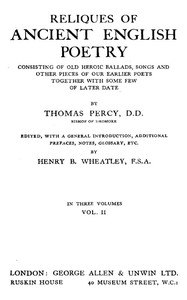
The second volume of Percy's Reliques opens with a striking variety of poetic forms and voices. The table of contents lists 26 pieces, from the political allegory of 'A Ballad of Luther, the Pope, a Cardinal, and a Husbandman' to the Scottish pastoral 'Robin and Makyne'. The excerpts reveal a deliberate editorial strategy: Percy juxtaposes heroic ballads like 'Sir Andrew Barton' with courtly lyrics and moral complaints, creating a mosaic of medieval and early modern English and Scottish verse. The inclusion of 'Copy from the Folio MS.' for several ballads signals the editor's interest in textual variation, inviting readers to compare versions.
Narrative Voice in the Heroic Ballads
The excerpt from 'Sir Andrew Barton' (Book the Second, no. 12) demonstrates a distinctive narrative voice that shifts between direct dialogue and swift action. The ballad opens with a reported speech: 'I was his prisoner but yester night, / and he hath taken mee sworne.' This first-person testimony gives way to the lord's command: 'you must gett a noble gunner.' The voice is terse, with short lines and frequent imperatives ('cutt my ropes!', 'strike on your drummes'). The dialogue drives the plot, and the narrator rarely intervenes, letting characters speak for themselves. This technique creates a sense of immediacy and dramatic tension, as seen in the exchange between Sir Andrew and his men: 'ffight on, my men!' The ballad's pace accelerates through repeated commands and the rapid succession of events—the pinnace is sunk, the mast felled, and sixty men killed in a few stanzas.
Pace and Variation Across Genres
The volume's arrangement juxtaposes fast-paced heroic ballads with slower, more reflective pieces. 'The Not-Browne Mayd' (Book the First, no. 6) is a dialogue poem with a measured, argumentative rhythm, while 'The Turnament of Tottenham' (no. 4) uses a mock-heroic style with a burlesque pace. The Scottish songs, such as 'The Gaberlunyie man' (no. 10) and 'John Anderson my Jo' (Book the Second, no. 2), introduce a different tempo: their refrains and simpler stanzas create a lyrical, repetitive structure. Percy's editorial notes often comment on the 'ancient' or 'modern' character of a piece, hinting at his awareness of how pace affects a reader's experience. The inclusion of 'An Essay on the Word Fit, and the ancient Ballad-singing' (after no. 10) suggests that the editor considered performance and rhythm integral to the ballads' effect.
Textual Variants and Editorial Voice
Percy and Wheatley's editorial apparatus adds a layer of scholarly commentary that contrasts with the ballads' plain style. For several pieces, the editors provide a 'Copy from the Folio MS.'—a variant text that allows readers to compare versions. In 'Sir Andrew Barton', the footnotes (not shown in excerpts) likely gloss archaic terms like 'charke-bord' or 'hache-bord'. The glossary and notes, compiled by Wheatley, serve as a guide to the language, but they also reveal the editors' assumptions about authenticity and textual authority. The presence of multiple versions for ballads such as 'The Heir of Linne' (no. 5) and 'Mary Ambree' (no. 19) underscores the fluidity of the oral tradition. Readers are thus invited to consider how a ballad changes in transmission, and how editorial choices shape the text we read.
This volume rewards readers who attend to the interplay between the ballads and their editorial framing. Percy's selections highlight the diversity of early English poetry, from martial exploits to domestic laments. The textual variants and notes offer a glimpse into the editorial process, while the ballads themselves showcase a range of narrative techniques. For those interested in the evolution of poetic form, the Reliques remains a valuable resource, best approached not as a unified anthology but as a collection of distinct voices, each with its own pace and purpose.
The rain kept time with the clipped dialogue of ‘Sir Andrew Barton’, and I found myself wanting fewer sea-storms, more of that inward ache beneath the words. Later, half-drowsing, I opened a slim volume and met Fidesa’s quiet grief — a different kind of ballad, turned inward. The old and the intimate held hands. Elizabethan Sonnet Cycles: Idea, Fidesa and Chloris — Inside the Classic settled beside Percy on the armchair, both of them murmuring about love’s stubborn shape.