About 286 minutes
Poems & Ballads (First Series) — Background and Themes
Science Fiction Utopias
65,710 recorded words. 6 minutes difference from this book's estimate.
View Gutenberg source #35402
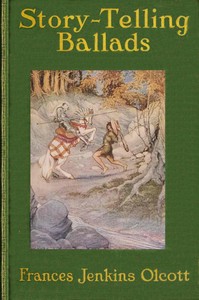
Before opening Story-Telling Ballads Selected and Arranged for Story-Telling and Reading Aloud and for the Boys' and Girls' Own Reading — Background and Themes, the edition data offers a quick orientation: 67,146 words, 4 hr 52 min estimated reading time, and 88 detected text sections.
The text analysis averages about 24.0 words per sentence, while the detected sections provide another way to judge how the source is divided.
Project Gutenberg metadata also associates the work with “Children's poetry, English,” connecting these edition facts with the source record’s subject description.
Explore this collection
These alternatives are selected using recorded categories and estimated reading time.
About 286 minutes
Science Fiction Utopias
65,710 recorded words. 6 minutes difference from this book's estimate.
View Gutenberg source #35402About 280 minutes
Science Fiction Utopias
64,246 recorded words. 12 minutes difference from this book's estimate.
View Gutenberg source #69681About 278 minutes
Science Fiction Utopias
63,746 recorded words. 14 minutes difference from this book's estimate.
View Gutenberg source #1030Search stored excerpts and compare books → Choose by your preferences →
Choices use stored catalog measurements. Estimates vary with reading speed. A shared category is a catalog label, not a claim that two books have the same argument or literary quality.
Search reads excerpt text stored with this catalog and links to its associated Gutenberg record. The connection is stored in the site database; this tool does not recheck that every excerpt is word-for-word identical to that external record. Excerpt search does not cover every chapter and does not verify historical publication dates.
Catalog snapshot checked: 2026-09-25. Coverage: 96 public books, 96 available source excerpts.
Read the complete public-domain text at its original source.
Read on Project GutenbergFrances Jenkins Olcott's 1920 anthology Story-Telling Ballads gathers 77 narrative poems chosen for their strong storylines and oral appeal. The editor deliberately preserves the archaic diction and stanza forms of traditional ballads, noting that texts are presented 'exactly as when in days of old they were sung by minstrels and recited by gaffers and gammers.' Only a few objectionable words are changed, and two or three lesser-known ballads are modernized in spelling. The collection spans Scots border ballads, faërie legends, and modern narrative poems, each selected to sustain a clear narrative arc suitable for reading aloud or independent enjoyment by readers aged twelve to fifteen.
Olcott's editorial hand is most visible in her fidelity to the original language of the ballads. In 'Blancheflour and Jellyflorice,' the dialogue retains Scots forms such as 'frae,' 'boud,' and 'weel-days,' and the narrative relies on formulaic repetition—'When other ladies get a gift, / O that ye shall get three'—that echoes the oral tradition. The glossary is placed at the back rather than in footnotes, a deliberate choice based on the editor's belief that 'children who are reading for enjoyment easily learn new words from the context.' This approach trusts the reader to absorb unfamiliar vocabulary through repeated exposure to the ballad's rhythmic patterns.
Many selections advance plot almost entirely through direct speech. In 'The Beggar-Maid,' Tennyson compresses the entire story into a single scene of dialogue and description: 'Her arms across her breast she laid; / She was more fair than words can say.' The king's oath—'This Beggar-maid shall be my Queen!'—serves as both climax and resolution. Similarly, 'Glenara' by Thomas Campbell builds suspense through a series of unanswered questions: 'Why speak ye no word?—said Glenara the stern.' The kinsmen's silence, followed by their dagger-display and the dream-revelation, creates a tight dramatic structure that rewards oral performance.
Olcott's selection favors ballads where setting carries emotional weight. 'Glenara' opens with a pibroch sounding 'sad in the gale' and a funeral procession moving 'over mountain and moor' to 'a heath, where the oak-tree grew lonely and hoar.' The landscape mirrors the clan's silent vengeance. In 'Blancheflour and Jellyflorice,' the queen's cruelty is enacted through a 'wild waith steed' and a ride 'round the cross'—a public space that becomes a site of peril. The supernatural elements, such as the dream that reveals a missing corpse in 'Glenara,' are presented without explanation, trusting the ballad's stark logic.
Several ballads in the collection hinge on hidden identities or sudden reversals of fortune. 'The Beggar-Maid' inverts social hierarchy when a king marries a barefoot woman. 'Lochinvar' (excerpted) features a hero who arrives from the West to steal a bride. The foreword promises tales of 'Kings in disguise' and 'proud and wicked folk' whose doings are 'related in the stirring, leaping, joyous—or at times martial and mournful—ballad measure.' These recurring motifs of disguise and reversal give the anthology a cohesive thematic thread, even as the individual ballads range from Scottish border raids to English faërie legends.
Readers encountering these ballads for the first time may find the Scots dialect and archaic phrasing initially challenging, but the strong narrative momentum and rhythmic repetition quickly carry the story forward. Olcott's arrangement rewards both silent reading and oral performance; the poems gain clarity when spoken aloud, as the meter and rhyme emphasize key dramatic moments. The glossary at the back is best consulted after a first reading, allowing the context to clarify unfamiliar terms naturally.
Reading these ballads, I remembered sitting by the fire as a girl, sounding out Scots words I didn't know, yet feeling the story entirely. It was like finding the same comforting rhythm in Bard—that quiet recognition of voices speaking across years. Sonnets of a Budding Bard — Background and Themes gave me that same sense of being gently trusted with old, strange, beautiful words.
Capture what you thought, learned, and would like to remember.