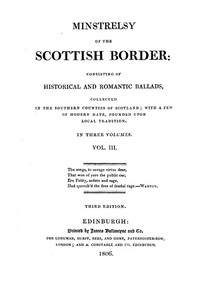
The third volume of Walter Scott's Minstrelsy of the Scottish Border juxtaposes two distinct modes: the stark, formulaic language of traditional ballads and the expansive, annotated prose of Scott's editorial apparatus. In ballads like 'Fause Foodrage,' repetitive phrasing and incremental repetition—'They had not been four months married, / As I have heard them tell'—create a hypnotic, oral rhythm. Conversely, Scott's historical notes on the Battle of Ancram Moor adopt a documentary tone, weaving together multiple chroniclers and direct speech, such as the Earl of Angus's exclamation about his 'white goss-hawk.' This volume thus becomes a study in contrasts between inherited folk forms and Enlightenment-era editorial commentary.
Repetition and Incremental Structure in the Ballads
The romantic ballads in this collection rely heavily on incremental repetition and formulaic phrasing. In 'Fause Foodrage,' the narrative advances through repeated couplets: 'They had not been four months married, / As I have heard them tell' and 'When bells were rung, and mass was sung, / And a' men bound to bed.' Such patterns, typical of oral tradition, slow the pace and emphasize key moments. The ballad also uses a recurring motif of keys—'four and twenty silver keys / Hang hie upon a pin'—to build suspense. Scott's decision to preserve these repetitions, rather than condensing them, highlights the genre's reliance on mnemonic devices and ritualistic storytelling.
Shifts in Narrative Voice: From Ballad to Historical Commentary
Scott's editorial notes introduce a markedly different voice. In the account of the Battle of Ancram Moor, the prose is dense with proper names, dates, and citations from Godscroft, Lesley, and Stowe. The narrative pace quickens through action verbs—'hurried precipitately forwards,' 'withdraw from the height'—and direct quotations, such as Angus's retort to Henry VIII: 'Little knows King Henry the skirts of Kirnetable.' This shift from the ballad's impersonal third-person to a historian's analytical perspective creates a layered reading experience. Scott also includes a folk epitaph for 'Fair maiden Lylliard,' blending oral tradition with scholarly annotation.
The Role of Place and Naming in Structuring the Volume
Place names and titles anchor the volume's geography. Ballads like 'Annan Water' and 'The Wife of Usher's Well' use locations as both setting and symbolic shorthand. In the historical notes, Scott meticulously identifies battlefields—'Panier-heugh, or Peniel-heugh'—and monuments, such as Lyliard's Edge. The catalog of contents reveals a deliberate ordering: romantic ballads precede 'Imitations of the Ancient Ballad,' which include Scott's own compositions like 'The Eve of St John.' This structure mirrors the volume's movement from collected oral texts to modern literary adaptations, underscoring the editor's role in shaping the border's literary heritage.
Readers attentive to shifts in register will find that Scott's volume rewards comparison between its constituent parts. The ballads' economy of language and the notes' scholarly expansiveness are not merely juxtaposed but interdependent: the notes illuminate historical contexts that the ballads compress into symbol. Approaching the text as a dialogue between these voices—rather than as a simple anthology—reveals Scott's editorial craft and the border's layered cultural memory.
We sit with old Walter Scott's cumbersome notes, battles weighed in heavy prose, and yet the ballads sing their spare, stark tunes beside them. It reminds me of a quieter kinship found in The Song of Deirdra, King Byrge and his Brothers, and Other Ballads — Reading Notes—a voice that hushes the noise, letting sorrow rest in a few plain words.