About 18 minutes
Queen Summer; Or, The Tourney of the Lily and the Rose — Themes and Context
Fantasy Juvenile Worlds
4,004 recorded words. 4 minutes difference from this book's estimate.
View Gutenberg source #24449
Before opening The Lost Temples of Xantoos — Edition Insights, the edition data offers a quick orientation: 3,200 words, 14 min estimated reading time, and 1 detected text section.
The text analysis averages about 25.4 words per sentence, while the detected sections provide another way to judge how the source is divided.
Project Gutenberg metadata also associates the work with “Poetry,” connecting these edition facts with the source record’s subject description.
Explore this collection
These alternatives are selected using recorded categories and estimated reading time.
About 18 minutes
Fantasy Juvenile Worlds
4,004 recorded words. 4 minutes difference from this book's estimate.
View Gutenberg source #24449About 25 minutes
Fantasy Juvenile Worlds
5,601 recorded words. 11 minutes difference from this book's estimate.
View Gutenberg source #26793About 25 minutes
Fantasy Juvenile Worlds
5,739 recorded words. 11 minutes difference from this book's estimate.
View Gutenberg source #28825Search stored excerpts and compare books → Choose by your preferences →
Choices use stored catalog measurements. Estimates vary with reading speed. A shared category is a catalog label, not a claim that two books have the same argument or literary quality.
Search reads excerpt text stored with this catalog and links to its associated Gutenberg record. The connection is stored in the site database; this tool does not recheck that every excerpt is word-for-word identical to that external record. Excerpt search does not cover every chapter and does not verify historical publication dates.
Catalog snapshot checked: 2026-09-25. Coverage: 96 public books, 96 available source excerpts.
Read the complete public-domain text at its original source.
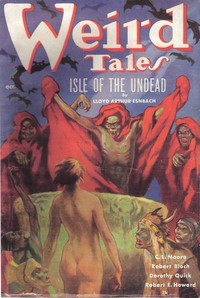
Read on Project GutenbergHowell Calhoun's The Lost Temples of Xantoos, a single sonnet first published in Weird Tales in October 1936, compresses a planetary ruin into fourteen lines. The poem opens with "celestial fantasies of deathless night" and proceeds through a series of jeweled, torch-lit images—"colonnades adorned with pearls," "sapphire torches' flames"—before narrowing to a "lurid shadow" standing within golden gates. The voice is formal and incantatory, relying on a consistent iambic pentameter and an ABAB CDCD EFEF GG rhyme scheme. The shift from the expansive "expanse of darkness silently unfurls" to the final, static image of the shadow creates a marked change in pace, moving from panoramic description to a pointed, unresolved conclusion.
The poem's language is deliberately ornate, drawing on a lexicon of precious materials and monumental architecture: "pearls," "crimson light," "gold," "sapphire torches," "jeweled gates." This accumulation of sensory detail establishes a tone of awe and loss. The phrase "monstrous idols' gilded frames" pairs the grotesque with the luxurious, hinting at a civilization both magnificent and threatening. The repeated use of possessives—"your altars," "your jeweled gates"—directly addresses the vanished city, creating an intimacy that contrasts with the scale of the ruins. The catalog of objects (colonnades, altars, idols, gates) functions as a series of static tableaux, each line adding a new element without narrative progression. This technique keeps the reader within a single, frozen moment of contemplation.
The sonnet's tight formal structure—three quatrains and a couplet—forces each image into a compressed space. The rhyme scheme links disparate elements: "night" with "light," "seas" with "memories," "flames" with "frames." These pairings create sonic echoes that reinforce thematic connections. The couplet, "Your jeweled gates swing open on their bands / Of gold; within, a lurid shadow stands," shifts from the descriptive to the ominous. The word "lurid" introduces a note of menace absent from the earlier, more reverent tone. The final line's iambic rhythm slows with the spondee "lurid shadow," emphasizing the static, watchful presence. The poem thus moves from a catalog of splendor to a single, unsettling image, using the sonnet's volta to pivot from memory to immediate threat.
The entire poem is set on "this barren core / Of Mars," a location named only in the eighth line. The setting is established through negation: "Nothing remains upon this barren core / Of Mars, but your palatial memories." The ruins are described as "colossal" and located on a "shore" once "purled by Xantoos' rolling seas." The use of "purled"—a word suggesting both the sound of water and the motion of knitting—adds a tactile quality to the vanished ocean. The poem does not describe a journey or action; instead, it presents a single, static vista. The only movement is implied: the "fragrant ring of sacred flowers nods" and the gates "swing open." These small motions within an otherwise frozen scene heighten the sense of a world suspended between decay and a lingering, active presence.
Readers approaching this sonnet should attend to how Calhoun uses the fourteen-line form to balance accumulation and revelation. The poem's power lies not in plot but in the tension between its ornate surface and the shadow that waits within. Noting the shift from plural to singular imagery—from "colonnades" and "altars" to a single "shadow"—may clarify the poem's trajectory. The work rewards attention to its sonic patterns and the way its vocabulary of luxury gradually yields to unease.
The rain kept time with Calhoun’s closing shadow—that quiet dread settling into the room. His ruined colonnades made me think of things left behind, and I found myself reaching for another old companion, one that hummed with lighter, stranger whimsy: Nonsense Songs — Themes and Context. Its nonsense felt less like escape and more like a different kind of ruin, gently smiling.
A brief reflection can help important ideas stay with you longer.