About 107 minutes
Elizabethan Sonnet-Cycles: Delia - Diana — Reading Companion
Fantasy Juvenile Worlds
24,552 recorded words. 7 minutes difference from this book's estimate.
View Gutenberg source #18842
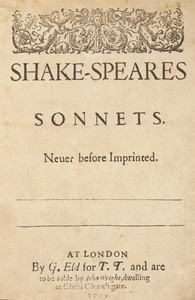
The catalog record for Shakespeare's Sonnets — A Reader’s Guide provides practical reading context through 22,889 words, 1 hr 40 min estimated reading time, and 155 detected text sections.
The text analysis averages about 35.8 words per sentence, while the detected sections provide another way to judge how the source is divided.
Project Gutenberg metadata also associates the work with “English poetry,” connecting these edition facts with the source record’s subject description.
Explore this collection
These alternatives are selected using recorded categories and estimated reading time.
About 107 minutes
Fantasy Juvenile Worlds
24,552 recorded words. 7 minutes difference from this book's estimate.
View Gutenberg source #18842About 76 minutes
Fantasy Juvenile Worlds
17,258 recorded words. 24 minutes difference from this book's estimate.
View Gutenberg source #42850About 126 minutes
Fantasy Juvenile Worlds
28,913 recorded words. 26 minutes difference from this book's estimate.
View Gutenberg source #27401Search stored excerpts and compare books → Choose by your preferences →
Choices use stored catalog measurements. Estimates vary with reading speed. A shared category is a catalog label, not a claim that two books have the same argument or literary quality.
Search reads excerpt text stored with this catalog and links to its associated Gutenberg record. The connection is stored in the site database; this tool does not recheck that every excerpt is word-for-word identical to that external record. Excerpt search does not cover every chapter and does not verify historical publication dates.
Catalog snapshot checked: 2026-09-25. Coverage: 96 public books, 96 available source excerpts.
Read the complete public-domain text at its original source.
Read on Project GutenbergThe opening sonnets immediately establish a pattern of economic and legal metaphor that runs throughout the sequence. The speaker addresses a young man as a 'beauteous niggard' and 'profitless usurer,' accusing him of hoarding beauty rather than investing it in offspring. This language of thrift and waste, of 'audit' and 'legacy,' frames procreation as a financial transaction with nature as the lender. The speaker's tone is urgent, almost scolding, as he warns that 'unused beauty must be tombed with thee'—a stark contrast to the later sonnets where the same speaker willingly accepts self-inflicted injury for the beloved's sake.
The first seventeen sonnets repeatedly accuse the young man of a paradoxical waste: he is both a 'glutton' and a 'niggard,' consuming what he refuses to share. Sonnet I calls him 'Thyself thy foe, to thy sweet self too cruel,' while Sonnet IV asks why he 'dost abuse / The bounteous largess given thee to give.' The metaphors are drawn from finance ('sum of sums,' 'audit'), agriculture ('unear'd womb,' 'tillage'), and law ('Nature's bequest gives nothing, but doth lend'). This cluster of images creates a coherent system: beauty is capital that must circulate, or it perishes. The speaker positions himself as an accountant of sorts, calculating the loss if the young man dies without an heir. Notably, the economic language is not merely decorative; it structures the argument of each sonnet, with the volta often shifting from accusation to a proposed remedy—usually procreation.
In stark contrast to the early sonnets' commanding tone, later sonnets (87–93) show the speaker adopting a posture of complete submission. He declares, 'For thy right, myself will bear all wrong' (Sonnet 88) and 'For thee, against my self I’ll vow debate' (Sonnet 89). The legal metaphor shifts from inheritance law to self-incrimination: the speaker offers to 'set down a story / Of faults conceal'd' to prove the beloved virtuous. This is a paradoxical logic—by accepting blame, he claims to gain 'double-vantage.' The language of contract and forfeiture reappears: 'Thus have I had thee, as a dream doth flatter, / In sleep a king, but waking no such matter' (Sonnet 87). The speaker's identity becomes contingent on the beloved's will, a voluntary bondage that inverts the earlier demand for the young man to submit to nature's law.
Time is personified as a tyrant throughout the sequence, but its operation is not uniform. In Sonnet V, 'never-resting time leads summer on / To hideous winter,' a seasonal decay that seems inevitable. Yet the speaker also imagines a kind of victory over time through art or memory—though the excerpts do not reveal how. The later sonnets introduce a different threat: the beloved's potential falseness. Sonnet 92 ends with the chilling admission, 'Thou mayst be false, and yet I know it not,' and Sonnet 93 imagines living 'like a deceived husband.' Here, time's damage is not physical decay but the erosion of trust. The speaker's earlier confidence in legacy gives way to a fragile hope that the beloved's 'looks' might still 'seem love' even if the heart is elsewhere. This tension between outward appearance and inward truth becomes a central preoccupation.
Readers approaching the sonnets as a sequence will notice how the speaker's stance shifts dramatically—from commanding advisor to abject supplicant—while the underlying metaphors of economy, law, and time remain consistent. Pay attention to the recurring words 'use,' 'waste,' 'true,' and 'false,' which carry different weights in different contexts. The incomplete excerpts leave open how the sequence resolves these tensions, but the patterns visible here reward careful comparison across individual sonnets.
I’ve spent years shelving books and overhearing their quiet conversations. Shakespeare’s sonnets speak of love as a ledger, a reckoning with time. And yet, against that weight, I often find myself returning to Love Sonnets of an Office Boy — Background and Themes, whose youthful verses share that same anxious urge to count every lingering moment before it slips away entirely.
Use these questions to collect your thoughts before moving on.