About 14 minutes
The Lost Temples of Xantoos — Edition Insights
Fantasy Juvenile Worlds
3,200 recorded words. 4 minutes difference from this book's estimate.
View Gutenberg source #33729
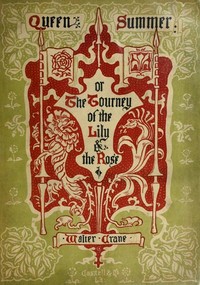
Queen Summer; Or, The Tourney of the Lily and the Rose — Themes and Context can be approached with a clearer sense of reading commitment from its source measurements: 4,004 words, 18 min estimated reading time, and 1 detected text section.
The text analysis averages about 28.8 words per sentence, while the detected sections provide another way to judge how the source is divided.
Project Gutenberg metadata also associates the work with “English poetry -- 19th century,” connecting these edition facts with the source record’s subject description.
Explore this collection
These alternatives are selected using recorded categories and estimated reading time.
About 14 minutes
Fantasy Juvenile Worlds
3,200 recorded words. 4 minutes difference from this book's estimate.
View Gutenberg source #33729About 25 minutes
Fantasy Juvenile Worlds
5,601 recorded words. 7 minutes difference from this book's estimate.
View Gutenberg source #26793About 25 minutes
Fantasy Juvenile Worlds
5,739 recorded words. 7 minutes difference from this book's estimate.
View Gutenberg source #28825Search stored excerpts and compare books → Choose by your preferences →
Choices use stored catalog measurements. Estimates vary with reading speed. A shared category is a catalog label, not a claim that two books have the same argument or literary quality.
Search reads excerpt text stored with this catalog and links to its associated Gutenberg record. The connection is stored in the site database; this tool does not recheck that every excerpt is word-for-word identical to that external record. Excerpt search does not cover every chapter and does not verify historical publication dates.
Catalog snapshot checked: 2026-09-25. Coverage: 96 public books, 96 available source excerpts.
Read the complete public-domain text at its original source.
Read on Project GutenbergWalter Crane's Queen Summer; Or, The Tourney of the Lily and the Rose opens with a formal court scene: Queen Summer holds court in a garden, with the hours personified as knights and ladies in a Masque of Flowers. The poem immediately establishes a conflict—a whispered word that the Lily flouts the Rose—and sets the stage for a tournament. Crane's verse is richly descriptive, with a consistent rhyme scheme and a focus on visual details: 'tapestry of leaves,' 'threads of gold the sun enweaves,' and 'velvet lawns the scythe smoothes o'er.' The opening lines also introduce the central conceit: the flowers are not merely decorative but active participants in a chivalric drama, with the queen as judge.
The middle excerpts describe the tournament itself in vivid, kinetic language. The Rose knight appears 'with crimson pennon fluttering new' and 'glittering spines all armed,' while the Lily knight is 'in silver armour white arrayed,' flashing 'like light upon the scene.' The clash is rendered as a sensory event: 'the summer winds the onset blew' and the knights 'clashed together, mid a snow / Of petals on the grass below.' The crowd's reaction—'Some cried, “the Lily”, some, “the Rose”'—mirrors the division between the two factions. Crane extends the combat beyond the initial duel: 'sudden charging from each side, / Of Roses and of Lilies ride / A host to still maintain the strife.' This escalation transforms the personal contest into a full-scale battle, with the grass 'undue was rife' from the 'fragrant blood' of roses.
Crane weaves chivalric terminology with botanical specificity throughout the excerpts. The Rose knight's 'glittering spines' evoke thorns, while the Lily knight's 'silver armour' and 'milk-white horse' recall the flower's pale petals. The Rose's supporters are described with horticultural precision: 'Rose-craft, since from wild thorn frail / Their order grew—through dark & pale / Of maiden-bloom to damask deep, / Or Gloire-de-Dijon that doth keep / Enfolded fire within his breast.' This passage names a specific rose cultivar (Gloire-de-Dijon) and traces the lineage of rose cultivation. Similarly, the Lily-lances are 'silver' and the charge is likened to 'a cloud of morn' or 'rosy wave on grassy shore.' The poem consistently blurs the line between floral and martial imagery, making the botanical world the arena for knightly combat.
The excerpts reveal a clear narrative arc: from the courtly setup, through the individual joust, to the massed battle. Crane uses a consistent ABAB rhyme scheme and a regular meter, which gives the poem a driving, ballad-like quality. The pacing accelerates with the tournament: the initial description of the queen's court is stately, but the combat sequences are swift and action-packed. The use of exclamations ('a sight to see!') and direct speech ('Some cried, “the Lily”') adds immediacy. The battle itself is described in a series of vivid images—'snow & burning flame / Mixing with the crimson flood'—that convey chaos and color. The excerpts break off mid-battle, leaving the outcome unresolved, which may reflect the poem's overall structure as a series of set pieces rather than a linear narrative.
Crane, primarily known as an illustrator, fills the poem with visual cues that suggest his own artwork. The 'blazoned shields, & pennons spruce / Of fluttering flag & fleur-de-luce' evoke heraldic designs, while the 'broidered hangings gay' and 'silver arum-trumpet's sound / With tongues of gold' create a richly decorated scene. The color scheme is dominated by red and white—the colors of the Rose and Lily—which recur throughout: 'their party-colours flaunting wide,' 'banners white and red,' and the 'crimson flood' of roses. The poem also uses light and metal imagery: the Lily knight 'flashed like light,' and his armor is 'silver,' while the Rose is 'aflame.' This symbolic opposition extends to the natural world: the battle is fought 'mid a snow / Of petals,' blending the white of the Lily with the red of the Rose. The excerpts suggest that the poem is as much a visual spectacle as a verbal one.
As you read Queen Summer, pay attention to how Crane balances the demands of narrative and description. The poem's brevity (around 4,000 words) means that every image and action carries weight. Notice how the floral and chivalric vocabularies interlock—the Rose knight's 'spines' are both thorns and armor, the Lily's 'silver' is both metal and petal. The excerpts leave the tournament unfinished, so consider whether the poem aims for resolution or simply revels in the spectacle. Crane's background as a designer and illustrator may also inform your reading: the text often reads like a caption for a series of imagined pictures.
That rainy afternoon, Queen Summer’s painted tourney felt almost trance-like, its porcelain petals and lances blurring into a dream of courtly ritual. Later, idly tracing the old ballad references in its margins, I stumbled onto Walter Scott’s border minstrels. The same vanished world—heraldry, faded flowers, vanished causes—resurfaced there, grayer and wilder, and just as haunting: Minstrelsy of the Scottish border, Volume 1 — Story, Setting & Ideas. That was the afternoon’s quiet twist.
Your answers remain private and are stored only in this browser.