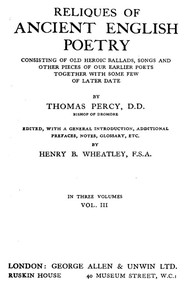
Percy's third volume opens with Arthurian ballads, including 'The Boy and the Mantle' and 'The Marriage of Sir Gawaine,' before moving into tragic love stories and moral exempla. The excerpts reveal a consistent pattern: ballads begin with a direct address or a swift plunge into action, often using incremental repetition and stark dialogue. For instance, 'George Barnwell' opens with the protagonist's resolve to visit his mistress, a decision that drives the narrative forward with a sense of inevitable doom.
Wheatley's editorial apparatus—prefaces, notes, and a glossary—frames these texts as historical artifacts, yet the ballads themselves retain a raw, performative energy. Readers should attend to the interplay between Percy's antiquarian framing and the living voice of the ballads, which often subvert simple moralizing through their vivid, unadorned storytelling.
Arthurian Beginnings and the Folio Manuscript
The volume's first book is devoted to poems on King Arthur, beginning with 'The Boy and the Mantle' and 'The Marriage of Sir Gawaine.' These ballads draw on the Arthurian legend but focus on tests of fidelity and honor rather than chivalric exploits. Percy includes a 'Copy from the Folio MS.' for 'King Arthur's Death,' signaling his editorial practice of comparing textual variants. The presence of multiple versions—such as the two copies of 'Gil Morrice'—invites readers to consider how oral transmission shaped these narratives. The ballads often employ a formulaic structure: a challenge, a test, and a revelation, as seen in the mantle that reveals women's faithfulness. This section establishes the volume's method of juxtaposing different textual traditions.
Tragic Love and Moral Warning in 'George Barnwell'
'George Barnwell' stands out as a lengthy, didactic ballad detailing a young apprentice's seduction and ruin. The excerpt shows Barnwell's gradual entrapment by the manipulative Sarah Millwood, who uses flattery and feigned distress to extract money and favors. The ballad's language is direct and repetitive, emphasizing Barnwell's naivety: 'Her words bewicht my childishness.' The narrative unfolds through a series of transactions—money, kisses, promises—that culminate in Barnwell's moral collapse. Percy likely included this as a cautionary tale, but the ballad's power lies in its psychological realism, particularly Millwood's calculated shifts between modesty and desire. Readers should note how the ballad uses incremental repetition to build tension, a technique common to the oral tradition.
Scottish Ballads and Regional Variation
Several ballads in the volume are marked as 'A Scottish Ballad' or 'A Scottish Song,' including 'The Ew-bughts, Marion,' 'Gil Morrice,' and 'Sweet William's Ghost.' These pieces often feature different dialects, stanza forms, and narrative conventions than their English counterparts. For example, 'Gil Morrice' appears in two versions—one from the Folio MS. and another—allowing comparison of textual stability. The Scottish ballads tend to emphasize supernatural elements, such as ghosts and fairy encounters, and employ a more lyrical, repetitive style. Percy's notes occasionally gloss Scots terms, but readers unfamiliar with the dialect may need to consult the glossary. This regional diversity enriches the collection, showing how the same story could be adapted across cultures.
Editorial Framing and the Reader's Role
Percy and Wheatley's editorial interventions shape how these ballads are read. The prefaces and notes provide historical context, source information, and occasional moral commentary. For instance, the note on 'George Barnwell' might explain its popularity as a cautionary tale. However, the ballads themselves often resist simple interpretation: 'The Children in the Wood' presents a tragic story of betrayal and death without explicit moralizing. Readers are encouraged to engage with the ballads as both literary artifacts and living performances, paying attention to the gaps between editorial framing and the raw emotional content of the verses. The glossary and textual notes are essential tools for understanding archaic language and allusions, but the ballads' power ultimately lies in their direct, unadorned storytelling.
As you read through this volume, consider how each ballad's structure—its repetitions, refrains, and dialogue—creates a sense of immediacy and communal storytelling. Percy's collection preserves not just texts but a mode of performance, where the reader becomes a listener. The editorial notes offer a guide, but the ballads themselves reward close attention to their rhythms and silences. Let the variations between versions and the regional dialects remind you that these poems were once fluid, shaped by each teller and audience.
That rainy afternoon, Percy’s old ballads felt less like reading than like listening to distant voices, especially “George Barnwell,” whose moral weight lingered long after the drizzle stopped. Its plain sorrow reminded me of quieter poems I once half-forgot, so I picked up Poems: Containing The Restropect, Odes, Elegies, Sonnets, &c. — A Closer Reading almost without deciding to. The rain kept falling, and one book simply handed me to the next.