About 84 minutes
Ballads — Context and Discussion
Historical Psychological Social Fiction
19,256 recorded words. 5 minutes difference from this book's estimate.
View Gutenberg source #413
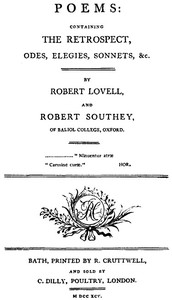
The source record for Poems: Containing The Restropect, Odes, Elegies, Sonnets, &c. — A Closer Reading measures this digital text at 20,364 words, 1 hr 29 min estimated reading time, and 5 detected text sections.
The text analysis averages about 27.9 words per sentence, while the detected sections provide another way to judge how the source is divided.
Project Gutenberg metadata also associates the work with “Sonnets, English,” connecting these edition facts with the source record’s subject description.
Explore this collection
These alternatives are selected using recorded categories and estimated reading time.
About 84 minutes
Historical Psychological Social Fiction
19,256 recorded words. 5 minutes difference from this book's estimate.
View Gutenberg source #413About 80 minutes
Historical Psychological Social Fiction
18,363 recorded words. 9 minutes difference from this book's estimate.
View Gutenberg source #76700About 77 minutes
Historical Psychological Social Fiction
17,650 recorded words. 12 minutes difference from this book's estimate.
View Gutenberg source #7164Search stored excerpts and compare books → Choose by your preferences →
Choices use stored catalog measurements. Estimates vary with reading speed. A shared category is a catalog label, not a claim that two books have the same argument or literary quality.
Search reads excerpt text stored with this catalog and links to its associated Gutenberg record. The connection is stored in the site database; this tool does not recheck that every excerpt is word-for-word identical to that external record. Excerpt search does not cover every chapter and does not verify historical publication dates.
Catalog snapshot checked: 2026-09-25. Coverage: 96 public books, 96 available source excerpts.
Read the complete public-domain text at its original source.
Read on Project GutenbergThe volume opens with a preface that borrows a 1633 metaphor of an over-cloying literary feast, acknowledging that little novelty can be expected in modern poetry. This self-aware framing sets the tone for a collection that moves between intimate retrospection and public declamation. The signature system—Bion for Southey, Moschus for Lovell—invites readers to distinguish the two voices, though the poems share a common vocabulary of ruins, storms, and chains.
The first poem, “The Retrospect,” establishes a journey metaphor: the speaker travels through the “vale of years,” calling on Memory to revive scenes before grief touched the heart. This opening movement from past to present, from sunny fields to lonely roads, recurs throughout the collection, often punctuated by exclamations and rhetorical questions that give the verse a dramatic, almost theatrical quality.
The opening poem, “The Retrospect,” uses a journey framework that reappears in later pieces. The speaker asks Memory to “view those days that will return no more,” a phrasing that echoes through the collection. The poem’s movement from “fond hopes” to “doubtful fears” establishes a pattern of emotional oscillation. In “To Lycon,” the pilgrim is warned to “stay thy heedless feet” and distrust “alluring pleasure’s deadly bowl.” The landscape shifts from sunny dales to barren rocks, mirroring the speaker’s inner state. This structural device—moving from a cheerful scene to a warning or lament—appears in several poems, creating a rhythm of expectation and reversal.
The journey is not only physical but temporal. The speaker in “The Retrospect” looks backward; in “To Lycon,” the pilgrim looks forward but is cautioned. The collection thus positions the reader as a traveler through time and emotion, with each poem offering a different vantage point on the same fundamental concerns: loss, hope, and the search for stability.
Ruins appear as both setting and symbol. In “To Lycon,” the speaker addresses a figure on a “wild waste of ruin,” beating her breast and tearing her hair. The scene is populated by nightshade, owls, and spectres—a gothic landscape that recurs in “The Miser’s Mansion” and “Elegy. The Decayed Monastery.” These poems share a vocabulary of desolation: “barren plain,” “drear domains,” “nerveless soul.” The ruins are not merely picturesque; they represent a psychological state. The speaker in “To Lycon” claims to have fled these domains and “broke thy agonizing chains,” yet the imagery persists, suggesting an ongoing struggle.
The decayed monastery elegy and the miser’s mansion both use architectural decay to comment on moral decay. The physical ruin becomes a mirror for spiritual or emotional ruin, a technique that gives the collection a consistent visual and thematic coherence.
Chains are a recurring image, appearing in “The Retrospect” as “slavery’s heart-appalling train” and in “To Lycon” as “soul-binding chain” and “galling chain.” The chain metaphor links personal grief to political oppression. In “The Retrospect,” the speaker laments that “Afric’s sad sons still wear the accursed chain,” a rare explicit political reference. Storms also recur: in “To Lycon,” the sky is “darkly dimm’d by clouds of strife,” and the speaker advises that “the oak defies the storm.” This natural imagery—storm, oak, reed—provides a counterpoint to the ruins. Where ruins suggest decay, the oak suggests resilience. The collection thus balances images of destruction with images of endurance, though the latter are often qualified by uncertainty.
The collection is jointly authored, with Southey signing as Bion and Lovell as Moschus. The preface acknowledges the difficulty of novelty, and the poems themselves often address a named listener—Orson, Lycon, Lydon—creating a sense of dialogue. In “The Retrospect,” the speaker asks “need I, Orson! tell my wish to thee?” and later “need I, Orson! name that friend to thee?” These apostrophes give the poems a conversational intimacy, even as the imagery remains formal and classical. The sonnets, addressed to abstract figures like Happiness, Fame, and Sensibility, shift to a more meditative mode. The variety of forms—ode, elegy, sonnet, narrative—suggests an attempt to cover a range of emotional registers, from public lament to private reflection.
Readers may find it useful to attend to the signatures and to the recurring images of storms, ruins, and chains as they move through the collection. The poems reward attention to their structural patterns—the journey that begins in hope and ends in warning, the landscape that shifts from sunny to barren. The two voices, though distinct in signature, share a common vocabulary and a common concern with the passage of time and the possibility of resilience.
I often think of Southey and Lovell’s storms and ruins when I come across the worn, honest voices in Yorkshire Dialect Poems (1673-1915) and traditional poems — A Reader’s Guide. Both books speak of enduring, ordinary grief, their chains and moorland winds muttering the same quiet hope across a century of difference.
A brief reflection can help important ideas stay with you longer.