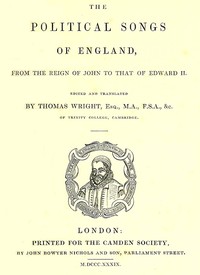
Thomas Wright's 1839 edition for the Camden Society gathers political songs from the reigns of John through Edward II, presenting them in their original Latin, Anglo-Norman, and Middle English alongside English translations. The collection's preface frames these poems as documents of partisan satire, popular exultation, and lament over national calamities—a lens that shapes the reader's encounter with each piece.
The songs themselves are dense with rhetorical devices: allegorical animals, biblical allusions, and sharp contrasts between clerical ideals and worldly corruption. Wright's editorial apparatus, including a glossary and notes on manuscript variations, signals the scholarly care behind the volume, while the facing-page format invites comparison between the original and the translation.
Clerical Satire and the Language of Complaint
The songs frequently target the clergy, using a vocabulary of decay and hypocrisy. In one Latin poem, the line “Adversatur legibus omne genus cleri, / Cujus status hodie pejor est quam heri” (Every class of the clergy is opposed to the laws, whose condition today is worse than yesterday) sets a tone of moral decline. The speaker adopts a prophetic stance, warning that priests who “will hold his own rites” are blind to their own corruption.
Wright's translation renders these complaints with a plainness that preserves the original's bite. The repeated use of “heri” (yesterday) and “hodie” (today) creates a temporal contrast that underscores the sense of a falling away from an earlier standard. This pattern of lament over ecclesiastical decay recurs across several songs, suggesting a sustained critique of institutional power.
Animal Imagery and Social Hierarchy
Several songs employ animal comparisons to mock pretension and inversion of social order. The Latin couplet “Quando contra boream nauta pandit velum, / Et asellus vincere cursu vult camelum” (When the sailor spreads his sail against the north wind, and the ass thinks to conquer the camel in the race) uses absurd juxtapositions to critique those who overreach their station.
Similarly, the she-goat that “wishes to be preferred to the sheep” (“Præferri bidentibus capra vult hirsuta”) is mocked for her folly in not recognizing her own coarse fleece. These images are not merely decorative; they encode a conservative social vision where each creature—and by extension, each class—should know its place. The translator's choice to keep the animals' names in English (ass, camel, goat, sheep) makes the allegory immediately accessible.
The Learned Fool: Logic and the Liberal Arts
A striking theme is the critique of academic learning, especially logic. The poet compares the logician to a spider spinning fine webs from its own entrails (“Logicus araneæ potest comparari, / Quæ subtiles didicit telas operari, / Quæ suis visceribus volunt consummari”), suggesting that scholastic reasoning is self-consuming and fruitless. The line “In arenam logicus frustra semen serit, / Nam metendi tempore fructus nullus erit” (The logician sows seed in the sand in vain, for at harvest time there will be no fruit) drives the point home.
Wright's translation captures the agricultural metaphor's irony: the logician's labor yields no crop. The poem contrasts this barren intellectualism with the practical rewards of law, noting that lawyers' halls are filled with wealth (“Affluunt divitiis legistarum sedes”). This tension between the ideal of learning and the reality of poverty recurs, giving the collection a self-aware, almost cynical edge.
Translation Choices and the Facing-Page Format
Wright's decision to place the original text and translation side by side shapes how readers encounter the songs. The translations are generally literal, aiming for clarity over poetic elegance. For instance, the Latin “Summa petit livor, perflant altissima venti” becomes “Envy aims at the highest, the winds blow on the highest places,” preserving the gnomic quality.
However, the format also reveals gaps: the final song, “Poem on the Evil Times of Edward II,” is left untranslated, a notable omission that Wright does not explain. The glossary and notes, inserted on the same pages as the songs, provide line-by-line references, encouraging close reading. This editorial structure invites comparison between the medieval voice and its modern rendering, highlighting the choices made in bridging centuries of linguistic change.
Readers approaching this collection should attend to the interplay between the original languages and Wright's translations, noting where the English smooths over ambiguities or sharpens satire. The songs reward attention to recurring motifs—clerical hypocrisy, social inversion, the futility of learning—and to the specific historical grievances that surface in each reign. Wright's edition, while scholarly, does not impose a single interpretation; it leaves the poems to speak, often bitterly, across the centuries.
I was thinking about how Thomas Wright’s songs carry that raw, clerical bite—so immediate, so full of living voices. It reminded me of sitting with Grimmer and Kamper, The End of Sivard Snarenswayne, and Other Ballads — Context and Discussion, and feeling the same strange ache: these old, pointed words still stirring a warmth that feels almost like my own.