About 195 minutes
Songs and Ballads of the Southern People: 1861-1865 — Reading Companion
Fantasy Juvenile Worlds
44,757 recorded words. 28 minutes difference from this book's estimate.
View Gutenberg source #35479
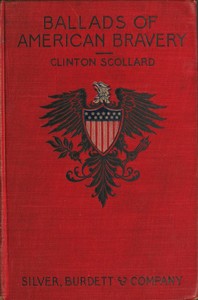
Ballads of American bravery — A Closer Reading can be approached with a clearer sense of reading commitment from its source measurements: 51,119 words, 3 hr 43 min estimated reading time, and 11 detected text sections.
The text analysis averages about 19.6 words per sentence, while the detected sections provide another way to judge how the source is divided.
Project Gutenberg metadata also associates the work with “American poetry,” connecting these edition facts with the source record’s subject description.
Explore this collection
These alternatives are selected using recorded categories and estimated reading time.
About 195 minutes
Fantasy Juvenile Worlds
44,757 recorded words. 28 minutes difference from this book's estimate.
View Gutenberg source #35479About 161 minutes
Fantasy Juvenile Worlds
36,823 recorded words. 62 minutes difference from this book's estimate.
View Gutenberg source #66385About 144 minutes
Fantasy Juvenile Worlds
32,928 recorded words. 79 minutes difference from this book's estimate.
View Gutenberg source #7846Search stored excerpts and compare books → Choose by your preferences →
Choices use stored catalog measurements. Estimates vary with reading speed. A shared category is a catalog label, not a claim that two books have the same argument or literary quality.
Search reads excerpt text stored with this catalog and links to its associated Gutenberg record. The connection is stored in the site database; this tool does not recheck that every excerpt is word-for-word identical to that external record. Excerpt search does not cover every chapter and does not verify historical publication dates.
Catalog snapshot checked: 2026-09-25. Coverage: 96 public books, 96 available source excerpts.
Read the complete public-domain text at its original source.
Read on Project GutenbergClinton Scollard's 1900 anthology Ballads of American Bravery assembles poems that commemorate "some signal act of valor historically verified," as stated in the prefatory word. The editor acknowledges a deliberate tension between historical accuracy and poetic merit, admitting a few selections of "lesser literary value" to cover a wider field. This editorial choice shapes a collection that prioritizes documented heroism over consistent literary quality, resulting in a volume that functions as both a patriotic record and a sampler of late-19th-century balladry.
The prefatory word explicitly limits the collection to poems based on "historically verified" acts, though Scollard concedes the line is "rigorously drawn." This commitment appears in the table of contents, which includes battles such as Ticonderoga, the Alamo, and Manila Bay. The editor's note on page 141 (referenced in the contents) suggests an apparatus that grounds the poems in specific events. However, the excerpts show that some poems, like Will Henry Thompson's "The High Tide at Gettysburg," blend historical figures (Hill, Gordon) with imagined scenes, such as a soldier's "cot in the Georgia wildwood" destroyed by "Sherman's torch." Scollard's inclusion of such pieces indicates a willingness to admit poems that elaborate on verified events with invented details, as long as the core act remains traceable.
Across the excerpts, certain images recur: the "crimson reek of hell" in "A Ballad of Manila Bay," the "spume of flame" in Thompson's poem, and the "red-throat furnaces" that "roar elate" aboard the fleet. These visceral descriptions of combat are paired with formal, often archaic diction—"dauntless boat," "iron hail," "the brave though beaten." The poems frequently employ ballad stanzas with alternating rhyme, and several use refrains or repeated lines, as in "Manila Bay! Manila Bay!" This formal consistency suggests Scollard selected poems that fit a recognizable ballad tradition, even when the subject matter was recent, such as the 1898 Battle of Manila Bay.
The collection spans the American Revolution, the War of 1812, the Civil War, and the Spanish-American War, yet the excerpts reveal an undercurrent of sectional reconciliation. Thompson's poem explicitly links "the Gray" and "the Blue" through "the bond of blood," ending with the line "His faith to the Blue, and the brave shall never / Question the brave in the sight of God." This sentiment appears alongside poems that celebrate Union and Confederate figures alike—Johnston at Shiloh, the Maryland Battalion, the Men of the Alamo. Scollard's editorial hand thus emphasizes a national, rather than sectional, bravery, even as the poems themselves often dwell on specific regional loyalties.
Readers approaching this collection should note its dual purpose: to serve students of American history and to appeal to a general audience through the universal theme of heroism. The poems vary widely in style and quality, from Longfellow's polished narrative to anonymous ballads and works by lesser-known poets. Scollard's notes, referenced in the contents, likely provide historical context that clarifies the boundary between fact and poetic license. Pay attention to the dates of composition—some poems were written decades after the events, others nearly contemporaneously—as this shapes their perspective and reliability as historical documents.
Reading these stanzas of documented bravery, I thought of my grandfather, who never spoke of the war but kept a worn anthology on his nightstand. I opened it once, and the quiet ache felt much like this collection. Vachel Lindsay’s General William Booth Enters into Heaven, and Other Poems — Edition Insights stirred the same solemn hush, a drumbeat of faith marching quietly toward something unnameable.
Use these questions to collect your thoughts before moving on.