
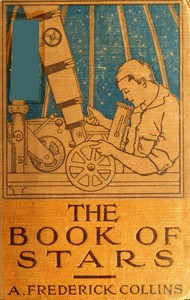
The Book of Stars: Being a Simple Explanation of the Stars and Their Uses to…
Published in 1912, A. Frederick Collins's The Book of Stars is exactly what its subtitle promises: a simple explanation. Forget complex equations or abstract theories. Collins writes for the curious beginner, the person who might feel intimidated by astronomy. He starts with the absolute basics—why the stars seem to move, what constellations are, and how to start spotting them. The book is structured as a gentle, progressive course. He builds your knowledge from identifying a few key star groups to understanding the planets, the nature of different stars, and even the basics of using a telescope.
The Story
There isn't a plot in the traditional sense. The 'story' is your own journey from ignorance to understanding. Collins acts as your guide. He begins by teaching you how to read a star map and 'star-hop' from familiar patterns to new ones. He weaves in the mythology behind constellation names, making the sky a canvas of ancient stories. Then, he shifts to practical science, explaining in clear terms what stars are made of, why they have different colors and brightness, and how their positions were used for navigation and creating calendars. The final chapters feel wonderfully ambitious for their time, touching on the scale of the universe and the life cycles of stars.
Why You Should Read It
What I loved most was the book's personality. You can feel Collins's enthusiasm on every page. He isn't just giving you facts; he's giving you a skill—the skill of looking up and knowing what you're seeing. In our age of light pollution and constant screen-gazing, this book is a quiet call back to a fundamental human experience: wondering at the night sky. His explanations, while occasionally dated in their specifics (we've learned a lot since 1912!), are logically sound and beautifully straightforward. The historical perspective is a bonus. Reading how people a century ago understood the cosmos is fascinating in itself.
Final Verdict
This book is perfect for the absolute beginner who finds modern astronomy guides too dense or technical. It's for the history enthusiast who enjoys seeing science explained through a vintage lens. It's also a fantastic, low-pressure read for parents or teachers who want to spark a sense of cosmic wonder in others. If you enjoy a direct, friendly, and slightly old-fashioned voice, Collins will feel like a great companion on a clear night. Just be ready to go outside and look up—that's the whole point.
This masterpiece is free from copyright limitations. You do not need permission to reproduce this work.






Amanda Allen
1 year agoVery helpful, thanks.