About 624 minutes
Biographia Literaria — A Reader’s Guide
Adventure Picaresque Fiction
143,297 recorded words. 44 minutes difference from this book's estimate.
View Gutenberg source #6081
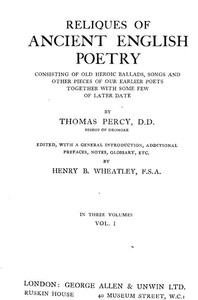
The catalog record for Reliques of Ancient English Poetry, Volume 1 (of 3) Consisting of Old Heroic Ballads, Songs and Other Pieces of Our Earlier Poets Together With Some Few of Later Date — Edition Insights provides practical reading context through 153,424 words, 11 hr 8 min estimated reading time, and 32 detected text sections.
The text analysis averages about 19.4 words per sentence, while the detected sections provide another way to judge how the source is divided.
Project Gutenberg metadata also associates the work with “English poetry -- Early modern, 1500-1700,” connecting these edition facts with the source record’s subject description.
Explore this collection
These alternatives are selected using recorded categories and estimated reading time.
About 624 minutes
Adventure Picaresque Fiction
143,297 recorded words. 44 minutes difference from this book's estimate.
View Gutenberg source #6081About 427 minutes
Adventure Picaresque Fiction
97,981 recorded words. 241 minutes difference from this book's estimate.
View Gutenberg source #60454About 333 minutes
Adventure Picaresque Fiction
76,541 recorded words. 335 minutes difference from this book's estimate.
View Gutenberg source #8648Search stored excerpts and compare books → Choose by your preferences →
Choices use stored catalog measurements. Estimates vary with reading speed. A shared category is a catalog label, not a claim that two books have the same argument or literary quality.
Search reads excerpt text stored with this catalog and links to its associated Gutenberg record. The connection is stored in the site database; this tool does not recheck that every excerpt is word-for-word identical to that external record. Excerpt search does not cover every chapter and does not verify historical publication dates.
Catalog snapshot checked: 2026-09-25. Coverage: 96 public books, 96 available source excerpts.
Read the complete public-domain text at its original source.
Read on Project GutenbergThomas Percy's Reliques of Ancient English Poetry (1765), here re-edited by Henry B. Wheatley, presents itself as a repository of old heroic ballads, songs, and pieces from earlier poets, yet its contents are conspicuously shaped by editorial intervention. The volume opens with the ancient ballad of Chevy-Chase and immediately offers a more modern version later in Book the Third, inviting comparison. Percy's footnotes—such as those citing Rimbault's Musical Illustrations (1850) or noting that a Robin Hood ballad is omitted because it 'may be found on every stall'—reveal a curator who both preserves and polishes. The inclusion of Percy's own composition, 'The Friar of Orders Gray,' further blurs the line between collector and creator.
The excerpts show Percy working from multiple sources—a folio manuscript, printed copies, and fragments—and openly noting discrepancies. For 'Sir Lancelot du Lake,' he explains that the song is 'given from a printed copy, corrected in part by a fragment in the Editor's folio MS.' The ballad 'Willow, Willow, Willow' appears with footnoted glosses (e.g., 'faithless' for 'falser,' 'change' for 'flit'), indicating an audience unfamiliar with older diction. Yet Percy does not always restore the earliest text; he sometimes prefers a later, more polished version. The 'more modern Ballad of Chevy-chace' in Book the Third stands as a deliberate counterpart to the ancient one, illustrating how the same story could be reshaped across centuries. This editorial pairing—ancient alongside modern—becomes a structural principle, forcing readers to consider what is gained or lost in transmission.
Book the Second is explicitly subtitled 'Containing Ballads that illustrate Shakespeare,' and the excerpts confirm this purpose. 'Sir Lancelot du Lake' is introduced as quoted in 2 Henry IV, and Percy notes that Silence in that play hums a scrap from a Robin Hood ballad. The ballad 'Take thy old cloak about thee' and 'Willow, Willow, Willow' are likewise tied to Shakespearean contexts. Percy's footnotes trace these connections meticulously: for 'Willow, Willow, Willow,' he cites Rimbault's Musical Illustrations; for 'Sir Lancelot,' he references Marston's Malcontent and Beaumont and Fletcher's Little French Lawyer as further witnesses to the ballad's popularity. This framing treats the ballads not as autonomous artifacts but as keys to understanding Elizabethan drama. The reader is invited to hear, in Desdemona's willow song, an echo of a much older tradition—one that Percy's collection helps recover.
Percy's General Introduction (included in the table of contents under 'The Minstrels') and his editorial notes reveal a persistent concern with the figure of the minstrel as author and transmitter. The ballad 'Sir Cauline' is accompanied by a 'Copy from the Folio MS,' suggesting an attempt to recover an authentic minstrel version. Yet Percy also includes his own imitation, 'The Friar of Orders Gray,' which mimics ballad style. The tension between authenticity and artifice is most visible in the footnotes: for 'Edom o' Gordon,' he prints both a Scottish ballad and a version 'from the Folio MS' titled 'Captain Carre,' implicitly comparing oral and written traditions. The glossary of 'early modern English' terms and the illustrations of northern names in Chevy-Chase further indicate that Percy saw his role as bridging a linguistic and cultural gap—making ancient poetry legible to a modern audience without entirely erasing its strangeness.
Readers approaching this volume should attend to the footnotes and prefatory matter as much as to the ballads themselves. Percy's editorial choices—which ballads he includes, how he annotates them, and where he inserts his own compositions—constitute a quiet argument about the value of old poetry. The presence of two Chevy-Chase ballads, the Shakespearean framing of Book the Second, and the careful glossing of archaic words all point to a work that is as much about the act of collecting as about the collected poems. To read the Reliques is to watch an eighteenth-century antiquarian shape the literary past for his own time.
The rain kept time with Percy’s old ballads, those frayed heroes stumbling through footnotes. By late afternoon, that same rough-hewn voice surfaced somewhere unexpected—in Leland’s comic verses, which I stumbled upon while chasing a citation. One book led to another, quietly, like footprints in wet grass. The Breitmann Ballads — Reading Notes caught the same unpolished spirit, just grinning differently.
Use these questions to collect your thoughts before moving on.