About 333 minutes
War Poetry of the South — Context and Discussion
Adventure Picaresque Fiction
76,541 recorded words. 94 minutes difference from this book's estimate.
View Gutenberg source #8648
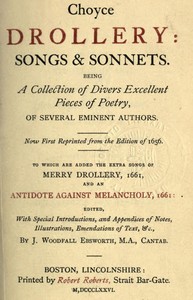
Before opening Choyce Drollery: Songs and Sonnets Being a Collection of Divers Excellent Pieces of Poetry, of Several Eminent Authors. — Background and Themes, the edition data offers a quick orientation: 97,981 words, 7 hr 7 min estimated reading time, and 19 detected text sections.
The text analysis averages about 20.3 words per sentence, while the detected sections provide another way to judge how the source is divided.
Project Gutenberg metadata also associates the work with “English wit and humor,” connecting these edition facts with the source record’s subject description.
Explore this collection
These alternatives are selected using recorded categories and estimated reading time.
About 333 minutes
Adventure Picaresque Fiction
76,541 recorded words. 94 minutes difference from this book's estimate.
View Gutenberg source #8648About 300 minutes
Adventure Picaresque Fiction
68,809 recorded words. 127 minutes difference from this book's estimate.
View Gutenberg source #42585About 286 minutes
Adventure Picaresque Fiction
65,672 recorded words. 141 minutes difference from this book's estimate.
View Gutenberg source #65524Search stored excerpts and compare books → Choose by your preferences →
Choices use stored catalog measurements. Estimates vary with reading speed. A shared category is a catalog label, not a claim that two books have the same argument or literary quality.
Search reads excerpt text stored with this catalog and links to its associated Gutenberg record. The connection is stored in the site database; this tool does not recheck that every excerpt is word-for-word identical to that external record. Excerpt search does not cover every chapter and does not verify historical publication dates.
Catalog snapshot checked: 2026-09-25. Coverage: 96 public books, 96 available source excerpts.
Read the complete public-domain text at its original source.
Read on Project GutenbergEbsworth's 1876 reprint of Choyce Drollery (1656) is not a simple facsimile but a layered editorial reconstruction. The volume gathers three distinct songbooks—Choice Drollery, Antidote Against Melancholy (1661), and Merry Drollery (1661)—alongside extensive notes, introductions, and appendices. Ebsworth frames these collections as artifacts of a 'Cromwellian time' when Cavalier wit operated under the shadow of Puritan prohibition. His preface explicitly summons 'the past Cromwellian time' through 'invocative rhyme,' positioning the drolleries as coded resistance. The editorial voice is combative: he derides 'gloomy zealots' and 'Regicidal stain,' while meticulously tracing textual lineages, variant readings, and the identities of obscure contributors. This is a scholarly edition with a political thesis, where every footnote becomes a skirmish in a long cultural war.
Ebsworth's introductions are openly polemical. He describes the Interregnum as a period when 'Old England' was 'torn by civil wars' and 'oppress'd by gloomy zealots.' The drolleries, he argues, were 'inhibited' by Puritan authorities, making their survival an act of defiance. This framing shapes his editorial choices: he highlights poems that mock Puritanism, celebrates royalist authors, and speculates about suppressed editions. For instance, he notes that Choice Drollery was 'inhibited' shortly after publication, though he offers no direct evidence beyond the title page's claim. His notes on individual poems often digress into biographical sketches of Cavalier poets, such as the 'reverent Elegy for Jonsonus Virbius' by Dudley Digges. The reader is never allowed to forget that these songs were weapons in a cultural war, not mere entertainment.
Ebsworth's appendices are dense with variant readings, emendations, and attribution debates. He compares the 1656 edition of Choice Drollery with later printings, noting discrepancies in wording and ordering. For example, he identifies a poem attributed to 'W. S.' and speculates about its authorship, drawing on parallels with known works by Sir John Suckling or Thomas Carew. He also reconstructs the publication history of Antidote Against Melancholy, arguing that its 'Ingredients' include poems by 'Arthur O'Bradley'—a pseudonym he attempts to unmask. The notes are a mix of erudition and conjecture: Ebsworth freely admits when evidence is lacking, but his tone remains authoritative. This scholarly apparatus transforms the volume into a detective story, where the editor is both historian and sleuth.
The drolleries themselves are a mix of love lyrics, satirical verses, and drinking songs, but Ebsworth's commentary consistently politicizes them. He reads a seemingly innocuous pastoral as a coded royalist lament, and a bawdy song as a jab at Puritan hypocrisy. In his notes, he compares the 'Sessions of Poets'—a mock-trial poem—to actual legal proceedings under the Commonwealth, suggesting that the genre served as a veiled critique of judicial corruption. He also draws attention to the physical layout of the original editions: the use of blackletter type, the placement of ornamental initials, and the inclusion of musical notation. For Ebsworth, these formal elements are not neutral; they are part of the drollery's rhetorical strategy, designed to evoke a lost Cavalier world of wit, leisure, and defiance.
Readers approaching this edition should be prepared for a dialogue between the 17th-century texts and their 19th-century editor. Ebsworth's voice is never far from the surface, and his biases are part of the experience. To engage fully, one must read both the poems and the footnotes, weighing Ebsworth's claims against the evidence he provides. The volume rewards those interested in the politics of literary preservation, the history of song, and the ways later editors shape our understanding of the past.
I finished that old Choyce Drollery last week, and it stayed with me—not for the songs, but for how the editor’s footnotes kept turning into quiet arguments about what was safe to say. It felt a bit like finding a friend’s marginalia in a borrowed book. That ache for context reminded me of another guide I once kept nearby: Biographia Literaria — A Reader’s Guide. Both made me feel like I was listening to someone think aloud, slowly, in the margins of history.
A brief reflection can help important ideas stay with you longer.