
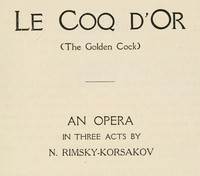
Le Coq d'Or (The Golden Cock): An Opera in Three Acts by Nikolay Rimsky-Korsakov et al.
Picking up the libretto for Le Coq d'Or feels like finding a strange, ornate box. You know there's music meant to go with it (Rimsky-Korsakov's score is famously dazzling), but the text alone is a complete and biting little story.
The Story
Tsar Dodon is a mess. His kingdom is under threat, and he's too tired and confused to deal with it. Enter a mysterious Astrologer who offers a solution: a magical Golden Cockerel. This bird will crow and point its beak whenever danger approaches. Dodon is thrilled—now he can nap in peace! Of course, the rooster eventually goes berserk, signaling a new threat. Dodon sends his sons to fight; they kill each other. When he goes himself, he doesn't find an army, but the stunning Queen of Shemakha. She mesmerizes him with song and dance, and he, like a fool, brings her home to marry her. Just as the celebration begins, the Astrologer returns to claim his payment: the Queen. Dodon refuses and kills him. The Golden Cockerel then swoops down and pecks Dodon to death. As everything goes dark, the Astrologer briefly reappears to tell the audience that maybe only he and the Queen were real. It's a whirlwind.
Why You Should Read It
What grabbed me was how this isn't just a fairy tale. It's a joke, a warning, and a piece of political art all wrapped in a fantastical package. Dodon is a hilarious and pathetic portrait of incompetent leadership—he wants a simple, mechanical solution (the rooster) for complex problems, and it backfires spectacularly. The Queen is fascinating; is she a manipulator, a victim, or just a force of nature? The story moves with dreamlike logic, where symbols are more important than strict realism. Reading it, you feel Rimsky-Korsakov and his librettist Vladimir Belsky poking fun at the Tsarist Russia of their day, but the themes of gullibility, the corruption of power, and the danger of easy answers feel totally current.
Final Verdict
This is a perfect quick read for anyone who loves opera, Russian literature, or political satire wearing a fantastical mask. It's great for readers who enjoy unpacking allegories (think Animal Farm but with a magical rooster). If you're an opera fan, reading the libretto deepens the experience of the music immensely. And if you just like weird, clever stories that you can finish in one sitting but think about for a lot longer, Le Coq d'Or delivers. Just don't expect a straightforward hero's journey—expect a darkly comic fable that ends with a fatal peck.
You are viewing a work that belongs to the global public domain. Use this text in your own projects freely.
Kenneth Jones
1 year agoUsed this for my thesis, incredibly useful.
Brian Thomas
1 year agoA bit long but worth it.