About 453 minutes
Poems of Rural Life in the Dorset Dialect — Key Ideas to Explore
Fantasy Juvenile Worlds
104,038 recorded words. 51 minutes difference from this book's estimate.
View Gutenberg source #21785
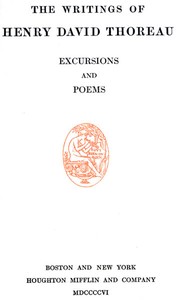
Excursions, and Poems The Writings of Henry David Thoreau, Volume 05 (of 20) — Inside the Classic can be approached with a clearer sense of reading commitment from its source measurements: 115,736 words, 8 hr 24 min estimated reading time, and 16 detected text sections.
The text analysis averages about 24.0 words per sentence, while the detected sections provide another way to judge how the source is divided.
Project Gutenberg metadata also associates the work with “American poetry,” connecting these edition facts with the source record’s subject description.
Explore this collection
These alternatives are selected using recorded categories and estimated reading time.
About 453 minutes
Fantasy Juvenile Worlds
104,038 recorded words. 51 minutes difference from this book's estimate.
View Gutenberg source #21785About 394 minutes
Fantasy Juvenile Worlds
90,482 recorded words. 110 minutes difference from this book's estimate.
View Gutenberg source #12742About 745 minutes
Fantasy Juvenile Worlds
171,298 recorded words. 241 minutes difference from this book's estimate.
View Gutenberg source #6652Search stored excerpts and compare books → Choose by your preferences →
Choices use stored catalog measurements. Estimates vary with reading speed. A shared category is a catalog label, not a claim that two books have the same argument or literary quality.
Search reads excerpt text stored with this catalog and links to its associated Gutenberg record. The connection is stored in the site database; this tool does not recheck that every excerpt is word-for-word identical to that external record. Excerpt search does not cover every chapter and does not verify historical publication dates.
Catalog snapshot checked: 2026-09-25. Coverage: 96 public books, 96 available source excerpts.
Read the complete public-domain text at its original source.
Read on Project GutenbergThoreau opens 'Walking' with a declaration that is at once a manifesto and a lexical performance: 'I wish to speak a word for Nature, for absolute freedom and wildness.' The sentence sets the tone for the entire volume, where excursions—whether to Quebec, Wachusett, or the local woodlot—become occasions for philosophical assertion. His prose is marked by a habit of redefining common terms: 'saunterer' is traced to the Holy Land, then contrasted with the rootless vagrant, all in service of elevating the pedestrian to a knightly order. This editorial note examines the authorial choices in diction, dialogue, and description across the collected works, focusing on how Thoreau constructs a voice that is at once intimate, combative, and etymologically inventive.
Thoreau frequently pauses his narrative to dissect a word, using its history to bolster his own claims. In 'Walking,' he devotes several paragraphs to 'saunterer,' offering two derivations: one from à la Sainte Terre (to the Holy Land), the other from sans terre (without land). He prefers the first, calling every walk 'a sort of crusade.' This is not pedantry but a rhetorical strategy: by grounding his practice in medieval pilgrimage, he transforms a simple stroll into a spiritual and heroic act. The same impulse appears in 'A Yankee in Canada,' where he notes the derivation of 'Quebec' from an Algonquin word for 'narrow,' linking geography to language. Such moments reveal a writer who treats dictionaries as field guides, and who expects his reader to share his delight in verbal archaeology.
Thoreau’s descriptive passages are rarely neutral. When he observes a natural scene, he often pivots to a moral or social critique. In 'Walking,' he laments that men 'love darkness rather than light' and will 'stare by the hour to see a juggler draw ribbons from his throat' while ignoring the genuine marvels of the woods. The same pattern recurs in 'Natural History of Massachusetts,' where a catalog of plants and animals becomes a rebuke to those who 'think that the higher law is the law of the market.' His descriptions are thus double-voiced: they record what is seen, but also what is missed by the unobservant. This technique gives his prose a persistent ethical charge, even in passages that seem purely descriptive.
Thoreau often addresses his reader directly, creating a sense of shared inquiry. In 'Walking,' he writes, 'If you are ready to leave father and mother... then you are ready for a walk.' The conditional 'if' implicates the reader in a test of sincerity. He also engages with literary and classical traditions: his translations of Æschylus and Pindar sit alongside poems like 'Greece' and 'The Aurora of Guido,' showing a writer who measures his own excursions against ancient models. The 'Introductory Note' informs us that 'A Yankee in Canada' was originally sent to Horace Greeley, and Thoreau’s tone there—at once reportorial and sardonic—suggests he was aware of a newspaper audience. This blend of intimacy and erudition is a hallmark of his authorial voice.
Thoreau’s descriptive style is precise and often unexpected. In 'Wild Apples,' he notes the 'apple blossoms' with a naturalist’s eye, but also with a poet’s sense of metaphor. The frontispiece of the volume, a carbon photograph of apple blossoms, hints at the interplay between observation and art. His sentences are frequently long, accumulating clauses like a walker gathering impressions. Yet he can be abrupt: 'Surely, men love darkness rather than light.' This variation in pace mirrors the rhythm of a walk—now leisurely, now arrested by a sudden insight. The excerpts show a writer who trusts his own perceptions and expects his reader to follow, step by step, through the undergrowth of his prose.
Readers approaching this volume will find that Thoreau’s excursions are never merely geographical. Whether he is describing the walls of Quebec or the fall of a leaf, his language insists on the moral and spiritual dimensions of attention. The poems, often overlooked, echo the prose in their concern with nature, independence, and the passage of time. To read Thoreau is to be drawn into a conversation about how we see the world—and how we might see it differently.
There’s something about Thoreau’s insistence on walking as a holy act that lingers, long after the book is shut. It makes me think of my own rambles, and of old verses tucked elsewhere—particularly in The Humorous Poetry of the English Language; from Chaucer to Saxe — A Closer Reading, where the wit feels just as unhurried, just as quietly observant of human folly.
Capture what you thought, learned, and would like to remember.