
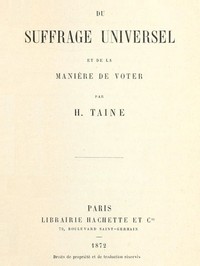
Du suffrage universel et de la manière de voter by Hippolyte Taine
Hippolyte Taine's Du suffrage universel et de la manière de voter isn't a story with characters and a plot in the traditional sense. Instead, it's a deep, critical examination of an idea in its infancy: letting every (male) citizen vote. Written in the late 19th century, Taine looks at the French experience with universal suffrage following the 1848 revolution. He doesn't just celebrate the principle; he dissects its practice with a sharp, skeptical eye.
The Story
Think of the 'story' as Taine's intellectual investigation. He starts with the grand promise of universal suffrage—the dream of popular sovereignty—and then follows it right down to the gritty reality. How do you organize an election? Who gets to run? How do you prevent manipulation? He analyzes the different voting systems of his time, pointing out their flaws and potential for distorting the public will. The narrative is his journey from theory to practice, showing how noble ideals can get tangled up in human nature, political machines, and simple logistical problems. It's the story of democracy's messy workshop.
Why You Should Read It
This book shook me because Taine writes like a brilliant, slightly cynical observer standing at the window of history. He's not trying to sell you on an ideology. Instead, he's pointing at the machinery of democracy and saying, 'Look how this part squeaks. See how that lever can be jammed?' His insights into group psychology and the ease with which masses can be swayed feel startlingly modern. Reading him, you realize the challenges we debate today—media influence, political polarization, the feeling that your vote doesn't count—aren't new. They're the foundational headaches of a system trying to govern itself. It gives you a profound sense of context for our current political moment.
Final Verdict
This is not a light read, but it's a rewarding one. It's perfect for anyone interested in political history, the roots of modern democracy, or just understanding why politics is so complicated. If you enjoy authors who challenge your assumptions and make you see familiar things in a new light, Taine is your guide. Be prepared for dense arguments and historical references, but the clarity of his critical thinking cuts through. You'll come away with a deeper, more nuanced appreciation for the incredible, fragile experiment we call voting.
This content is free to share and distribute. Thank you for supporting open literature.
Christopher Jones
1 year agoAfter hearing about this author multiple times, the character development leaves a lasting impact. A true masterpiece.
Susan Anderson
7 months agoI stumbled upon this title and the character development leaves a lasting impact. I would gladly recommend this title.
Kevin Thomas
1 year agoThis book was worth my time since the plot twists are genuinely surprising. I would gladly recommend this title.
Mark Sanchez
9 months agoFast paced, good book.