About 118 minutes
Rippling Rhymes — Key Ideas to Explore
Adventure Picaresque Fiction
26,991 recorded words. 8 minutes difference from this book's estimate.
View Gutenberg source #22692
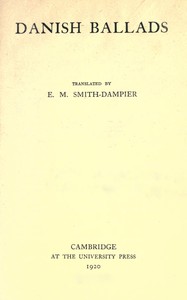
For Danish ballads — Reading Companion, the stored edition analysis reports 28,973 words, 2 hr 6 min estimated reading time, and 24 detected text sections.
The text analysis averages about 19.6 words per sentence, while the detected sections provide another way to judge how the source is divided.
Project Gutenberg metadata also associates the work with “Danish poetry -- Translations into English,” connecting these edition facts with the source record’s subject description.
Explore this collection
These alternatives are selected using recorded categories and estimated reading time.
About 118 minutes
Adventure Picaresque Fiction
26,991 recorded words. 8 minutes difference from this book's estimate.
View Gutenberg source #22692About 117 minutes
Adventure Picaresque Fiction
26,751 recorded words. 9 minutes difference from this book's estimate.
View Gutenberg source #26715About 143 minutes
Adventure Picaresque Fiction
32,870 recorded words. 17 minutes difference from this book's estimate.
View Gutenberg source #17364Search stored excerpts and compare books → Choose by your preferences →
Choices use stored catalog measurements. Estimates vary with reading speed. A shared category is a catalog label, not a claim that two books have the same argument or literary quality.
Search reads excerpt text stored with this catalog and links to its associated Gutenberg record. The connection is stored in the site database; this tool does not recheck that every excerpt is word-for-word identical to that external record. Excerpt search does not cover every chapter and does not verify historical publication dates.
Catalog snapshot checked: 2026-09-25. Coverage: 96 public books, 96 available source excerpts.
Read the complete public-domain text at its original source.
Read on Project GutenbergThe translator E. M. Smith-Dampier states she has “reproduced the metrical variations of the original Ballads,” prioritizing literal accuracy over poetic effect. The collection spans historical figures like Valdemar and Queen Dagmar, legendary heroes such as Holger Danske, and magical encounters with mermen and elves. A recurring structural feature is the use of burdens—refrains placed only at the beginning and end of each ballad, following modern custom. The preface acknowledges the late Dr. Axel Olrik for criticism and his executors for permission to use some of his ballad-versions.
Smith-Dampier’s preface foregrounds her method: she has “striven in general rather for literal accuracy than poetical effect.” This is evident in the irregular line lengths and stanza forms that mirror the Danish originals. For instance, in “Oh, Seventy-seven Twice-told were They,” the stanza pattern shifts between a longer narrative line and a short refrain: “—There sounds thunder the captains under, when they ride forth.” The translator also notes a single lapse in pronunciation—treating “Sir Klaus Krummerdike” in the Danish fashion—which she humorously hopes will “deserve rather mercy than judgment.” Such details reveal a translator attentive to the sonic texture of the source language, even when it complicates English prosody.
The ballads repeatedly employ heraldic imagery and games of chance to structure combat. In “Oh, Seventy-seven Twice-told were They,” each warrior is identified by a shield device: a lion, hammer and tongs, a golden serpent, a wolf, a vulture, a fiddle and bow, an elephant, a swarthy vulture, two arrows, a burning brand, and a cowl. These emblems are not merely decorative; they signal the bearer’s identity and role—the monk Brother Alsing, for instance, “would follow fain the fray.” Dice also determine who fights whom: “On the board they cast the dice / That fell both far and wide, / And the lot it was young Humlunger’s / With Sivord there to ride.” This blend of chance and emblematic display gives the combat a ritualistic, almost game-like quality.
Several ballads in the collection involve mermen, elves, or enchanted maidens, often with a stark economy of action. In “Agnes and the Merman,” the title suggests a cross-species encounter typical of Danish folk tradition. The ballad “The Knavish Merman” implies trickery or deception. These supernatural figures are not elaborated into full fantasy worlds; instead, they appear within the compressed, formulaic structure of the ballad stanza, where a single stanza can shift from dialogue to fatal consequence. The translator’s choice to retain the original metrical variations means that these encounters retain the abrupt, incantatory rhythm of the oral tradition, where the uncanny is rendered matter-of-factly.
Readers approaching this collection should attend to the interplay between the translator’s stated literalism and the inherent musicality of the ballads. The burdens, though placed only at beginning and end, hint at a performance context that the printed page can only partially convey. The historical ballads, in particular, gain resonance when read alongside the legendary and magical ones, as the same formal devices—repetition, incremental dialogue, sudden violence—serve both chronicle and fantasy.
The rain drummed against my window, and I kept returning to that strange Danish ballad where dice decide a hero’s fate. The starkness stayed with me. Later, almost by chance, I opened Servian Popular Poetry — Context and Discussion and found the same quiet weight, the same acceptance of chance and shadow, waiting in those unfamiliar verses.
Create a short personal record of your experience with this book.