About 286 minutes
Modern Street Ballads — Story, Setting & Ideas
Adventure Picaresque Fiction
65,672 recorded words. 14 minutes difference from this book's estimate.
View Gutenberg source #65524
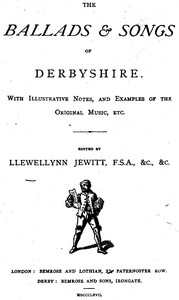
This digital edition of The Ballads & Songs of Derbyshire With Illustrative Notes, and Examples of the Original Music, etc. — Story, Setting & Ideas is described by source-level measurements including 68,809 words, 5 hr estimated reading time, and 16 detected text sections.
The text analysis averages about 26.8 words per sentence, while the detected sections provide another way to judge how the source is divided.
Project Gutenberg metadata also associates the work with “Ballads, English -- England -- Derbyshire -- Texts,” connecting these edition facts with the source record’s subject description.
Explore this collection
These alternatives are selected using recorded categories and estimated reading time.
About 286 minutes
Adventure Picaresque Fiction
65,672 recorded words. 14 minutes difference from this book's estimate.
View Gutenberg source #65524About 333 minutes
Adventure Picaresque Fiction
76,541 recorded words. 33 minutes difference from this book's estimate.
View Gutenberg source #8648About 234 minutes
Adventure Picaresque Fiction
53,625 recorded words. 66 minutes difference from this book's estimate.
View Gutenberg source #454Search stored excerpts and compare books → Choose by your preferences →
Choices use stored catalog measurements. Estimates vary with reading speed. A shared category is a catalog label, not a claim that two books have the same argument or literary quality.
Search reads excerpt text stored with this catalog and links to its associated Gutenberg record. The connection is stored in the site database; this tool does not recheck that every excerpt is word-for-word identical to that external record. Excerpt search does not cover every chapter and does not verify historical publication dates.
Catalog snapshot checked: 2026-09-25. Coverage: 96 public books, 96 available source excerpts.
Read the complete public-domain text at its original source.
Read on Project GutenbergLlewellynn Jewitt's 1867 collection gathers over fifty ballads and songs 'purely Derbyshire,' drawn from broadsheets, garlands, and oral tradition. In his introduction, Jewitt notes that no previous attempt had been made to collect these 'valuable and interesting remains,' and he provides each piece with an introductory notice touching on the event commemorated, the writer, or the source. The volume includes music examples and midi links for some pieces.
The excerpts offer a striking example of the collection's range: a long, first-person confession from a figure who describes a life of 'lustlie libertie,' secret plotting, and eventual ruin. The speaker moves from taverns and 'dayntie dames' to courtly favor, then to treasonous conspiracy with 'Padgett, Morgan, and others of that crewe.' The language is dense with moral self-examination and political danger.
The longest excerpt presents a first-person narrative of moral and political transgression. The speaker recounts a youth spent in 'myscheife,' neglecting church and marriage, then rising at court through 'gesture and talke' while secretly plotting. The voice is unsparing: 'I was content to playe a traytors parte.' This is not a simple ballad but a detailed, remorseful account of ambition and conspiracy, using the metaphor of 'Iccarus aloft' to describe a fall from grace. The editor's note likely identifies the historical figure, but the text itself stands as a vivid psychological portrait.
Jewitt explains that he avoided chronological arrangement, instead varying the contents and providing introductory notes. Many ballads come from 'old broad-sheets and garlands' never before reprinted; others were 'taken down from the lips of old inhabitants' or from original manuscripts. This mix of print and oral sources gives the collection a dual character: some pieces are literary artifacts, others are living traditions. The editor's dedication to the Duke of Devonshire and his plan for a 'Second Series' suggest a systematic effort to document Derbyshire's folk heritage.
The confessional excerpt uses a rich, archaic vocabulary of moral failure: 'spotted our conscience,' 'spoiled our good name,' 'Judas kisse.' The speaker describes his hypocrisy in court, where he 'fawned openlie' but 'inwardlie did hate.' Political plotting is framed in religious terms—'Catholicks still conversant' who 'looked for a daye'—and the conspiracy involves 'parlinge with parasites' and 'counsell of Caterpillers.' The poem's structure, with its repeated moral refrains and detailed self-accusation, resembles both medieval complaint and Tudor political verse.
Because the excerpts are incomplete, the reader encounters only a fragment of one ballad—likely a long, narrative piece—without its introductory note or musical setting. This fragment suggests that Jewitt's collection includes not just light songs but serious, historically charged poems. A first-time reader should expect variety: some ballads may be comic or local, others political or devotional. The editor's notes are essential for context, as they explain events, authors, and sources. The midi links offer an auditory dimension, though the texts themselves reward attention to dialect, meter, and archaic spelling.
Jewitt's volume invites readers to explore Derbyshire's literary past through ballads that range from tavern songs to treason confessions. The confessional excerpt, with its dense moral and political language, hints at the collection's depth beyond mere local color. Readers will benefit from consulting the introductory notes for each piece and from comparing the printed texts with the musical examples where available.
I kept thinking about that old Derbyshire collection, the way those ballads whispered secrets you weren’t sure you should hear. It reminded me of another book, Modern Street Ballads — Story, Setting & Ideas, which carries that same quiet ache—stories of ordinary people stumbling, and the weight they drag along afterwards. Its pages feel like a friend’s hesitant confession, lingered on long after closing.
Create a short personal record of your experience with this book.