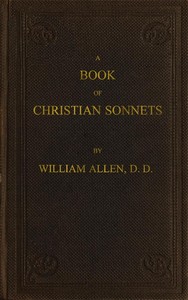
William Allen, a former president of Bowdoin College and author of the American Biographical Dictionary, published A Book of Christian Sonnets in 1860 from a sick chamber he had occupied for a year. The preface frames the work as a deliberate formal experiment: Allen argues that the sonnet, with its 'fixed laws and its structure,' is 'the very best form of poetry for one short, complete, meditative lesson.' He claims this volume as 'the first book of American Sonnets ever published,' a statement that reflects both his ambition and the relative scarcity of the form in nineteenth-century American poetry.
Formal Debts and Disagreements
Allen's preface reveals a careful engagement with English sonnet traditions. He singles out Milton's sonnets 8, 9, 14, 15, 18, 19, 22, and 23 as unequaled, praising their blend of 'melody of rhyme' with 'the unshackled freedom and energy of blank verse.' He quotes Milton's sonnet on blindness to illustrate this ideal. Wordsworth receives more ambivalent treatment: Allen credits him with applying the sonnet to 'higher subjects' than Petrarch, but faults him for abolishing Milton's method of designating stanzas, making the rhyme scheme hard to follow. He also charges Wordsworth with writing too many sonnets that are 'often diffuse and languid.'
The Poet's Circumstances and Purpose
Allen describes himself as 'an old man, the tenant for a year past of a sick chamber,' aware of his 'liableness at any moment to be summoned away.' This awareness shapes the volume's content: he could not excuse himself for 'drawing idle, uninstructive, unprofitable pictures.' Instead, his mind was 'filled with intense thoughts on God's pure, unchanging, soul-saving Truth.' The notes appended to the sonnets are meant to clarify what the brevity of verse might leave obscure, and to reinforce 'the unevasible claims and the infinite worth of the revealed Christian truth.' The preface thus presents the sonnets as both personal meditation and doctrinal instruction.
A Claim to American Literary Priority
Allen asserts that while Petrarch, Spenser, Shakespeare, and Wordsworth wrote many sonnets, 'not more than half a dozen sonnets—within his knowledge—have ever been sent forth by any one of our poets.' This claim positions his volume as a pioneering work in American poetry, though it is worth noting that Allen's knowledge may have been incomplete. The preface does not mention earlier American sonneteers such as Richard Alsop or James Gates Percival. The assertion is made in passing, without elaboration, and the volume's primary aim remains religious meditation rather than literary nationalism.
Readers approaching A Book of Christian Sonnets should attend to the interplay between Allen's formal conservatism and his evangelical purpose. The notes, which include historical dates and biblical references, are integral to the project, not mere appendices. Allen's critical remarks on Wordsworth and his admiration for Milton offer a window into his poetic values. The volume rewards those who read the sonnets alongside the preface and notes, as the three parts together constitute a unified argument for the sonnet as a vehicle for Christian instruction.
There’s something tender about a book written from a sickbed, each sonnet a held breath, a complete thought offered slowly. Allen’s insistence on the meditative pause stays with you. It reminds me of the quieter loneliness in The Dalby Bear, and Other Ballads — A Reader’s Guide, where old stories carry their own patient weight. Both feel like lanterns kept lit for no one in particular.