
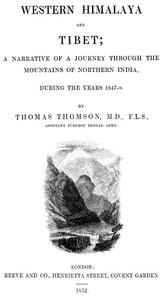
Western Himalaya and Tibet by Thomas Thomson
I grabbed this book because I love old travel writing—the kind where authors get their hands dirty, nearly fall off cliffs, and describe everything from the taste of fermented yak milk to the architecture of a Tibetan monk's home. Thomas Thomson never lets you down. Western Himalaya and Tibet feels less like a scientific journal and more like a friend's letter home, except that friend had a serious talent for painting pictures with words.
The Story
It's 1847. Thomson, a young-ish botanist, joins a mission to survey the border between India and Tibet. He trudges from the hot Indian plains, over passes high enough to give him altitude sickness, and into cold, dry landscapes that look like another planet. Along the way, he meets locals who are suspicious of him and British officials working on ten million paperwork dramas. He hunts for new plant species and everyday survival when it gets cold, wet, and risky. There's talk of crossing the famous 'Chibhar' pass into Tibet—a spot that supposedly has gold-covered lamaseries? We're treated not to treasure chess but real, gritty highs and lows: crossing shaky bridges, days without decent sleep, languages clogged by accents, and border agents who just won't let him go anywhere easy.
Why You Should Read It
I loved that this isn't just about flowers and statistics. Thomson cares about craft. He tells you when his translators mess up a name, when the local hunters' arrows look more accurate than his own, and when the scenery wrecks his ability to scribble notes (just once, he has to crawl to camp because of a storm). It feels very honest—no bravado, no attempt to make himself look like a hero. Plus, you learn heaps, almost accidentally. How teams trained tough ponies for the snowy heights? How local merchants trade walnuts for silk and show no fear of the East India Company? Stuff you won't find in your general Web search. The big awkward truth at the heart? Thomson clearly wants good relations and good science, but the British political machine often messes things. Still, his simple humility and absolute fascination with tough, high places pulled me nonstop. I nodded while reading the amazing description of Chinese officials' formal gift sessions. The contrast—the tea-less, cold India high-altitude plain calls 'Cha' but regular India dry tea...
Final Verdict
This is perfect for history lovers who treasure cultural detail over non-stop plot. And for nature or mountain-reading types who wonder 'what happens besides the climbing?'—because here most battles are just man vs hypothermia, strange tundra flowers, and impossible border policy. If you liked Into the Silence but want thriftier writing, or you've wandered this region nearly wanting original old names, buy. Thomson, in tired coffee-scented letters from 1852, has managed to hold something we still rareness: a voice generous to everyone, oddball confident about its speculations. Recommended highly for early night reading blankets.
This work has been identified as being free of known copyright restrictions. Enjoy reading and sharing without restrictions.
Karen White
2 weeks agoIt’s rare to find such a well-structured narrative nowadays, the structural organization allows for quick referencing of key points. I’ll definitely be revisiting some of these chapters again soon.
Donald Brown
5 months agoThe clarity of the introduction set high expectations, and the formatting on mobile devices is surprisingly crisp and clear. It definitely lives up to the reputation of the publisher.
Emily Lee
5 months agoLooking at the bibliography alone, the attention to detail regarding the core terminology is flawless. It cleared up a lot of the confusion I had previously.
Margaret Gonzalez
6 months agoThe author provides a very nuanced critique of current methodologies.




David Miller
7 months agoIt effectively synthesizes complex ideas into a coherent whole.