
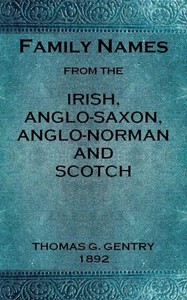
Family names from the Irish, Anglo-Saxon, Anglo-Norman and Scotch : Considered…
Let's be clear: this isn't a novel with a plot. Think of it more like a map, or a very detailed argument. Thomas G. Gentry, writing in the late 1800s, sets out on a mission. He looks at the United States, this giant mixing pot of people, and asks a simple but powerful question: What do our last names tell us about our shared story?
The Story
Gentry's "story" is his investigation. He gathers up what he sees as the most common family names in America and sorts them into four big buckets. He traces "Murphy" back to Ireland, "Smith" to the Anglo-Saxons, names like "Burke" to the Anglo-Normans who invaded England, and "Campbell" to Scotland. Page by page, he builds his case, showing the history and meaning packed into each name. The conflict isn't between characters, but between ideas—the idea of a random, new American identity versus Gentry's claim that our roots are specifically and deeply anchored in these old worlds. The book is his evidence laid out for the jury, which is you, the reader.
Why You Should Read It
What grabbed me was the personality. This isn't a cold, modern database. It's one man's passionate, sometimes old-fashioned, perspective. You can feel Gentry's pride and his desire to make sense of a growing nation. When he explains that "Fitzgerald" means "son of Gerald" and ties it to the Norman conquest, it suddenly makes history feel personal. It turns a name on a mailbox into a tiny piece of a thousand-year-old saga. Reading it now is a double journey: you learn about name origins, but you also step into the mind of an American from a different time, seeing how he connected his present to the past.
Final Verdict
This book is perfect for history buffs, genealogy hobbyists, or anyone who's ever stared at their surname and been curious. It's especially great if you have one of those classic last names from the British Isles. Just go in knowing it's a product of its time—some ideas are dated. Don't read it as the final, absolute truth. Read it as the start of a conversation, a compelling first draft of America's name story written by a guy who really cared about the subject. It's a unique and thoughtful peek into both family history and American thought over a century ago.
This text is dedicated to the public domain. Use this text in your own projects freely.
Linda Brown
1 year agoHonestly, the author's voice is distinct and makes complex topics easy to digest. I would gladly recommend this title.
Sarah Davis
9 months agoI started reading out of curiosity and the depth of research presented here is truly commendable. Worth every second.
Jennifer Miller
11 months agoA must-have for anyone studying this subject.
Matthew Thompson
1 year agoI had low expectations initially, however the flow of the text seems very fluid. A valuable addition to my collection.




Ethan Lee
1 year agoBeautifully written.